
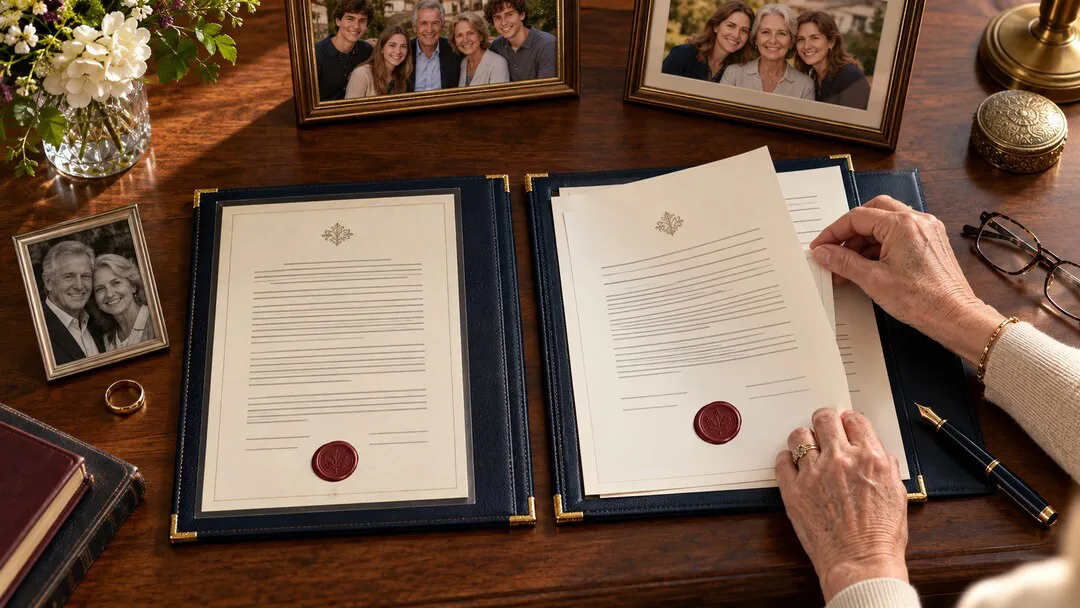
Mirror Wills can feel like a firm agreement. A couple signs two matching documents, usually leaving everything to one another and then to their children after the second death.
That naturally creates an expectation: whichever partner survives will keep the same plan in place.
Legally, however, ordinary mirror Wills are not usually binding on the survivor. Each person has their own Will and, while they retain mental capacity, they can generally revoke or replace it.
For couples with children from previous relationships, that distinction can determine whether the first partner’s children eventually inherit anything at all.
What are mirror Wills?
Mirror Wills are two separate Wills containing the same or very similar instructions. They are commonly used by married couples, civil partners and long-term partners who want broadly matching arrangements.
A typical pair might say:
- when the first partner dies, their estate passes to the survivor; and
- when the survivor later dies, the remaining estate passes equally to the couple’s children.
The documents “mirror” each other, but they do not become one joint Will. Each belongs to the person who signed it and takes effect only when that person dies.
This means either partner can change their own Will during their lifetime. They should not assume that matching wording creates a permanent contract between them.
Can mirror Wills be changed after the first death?
Yes, in most cases.
When the first partner dies, their own Will becomes effective and can no longer be changed by the survivor. However, the survivor’s Will remains their personal document. If they still have testamentary capacity, they can normally make a new Will or add a valid codicil.
The survivor may change executors, alter percentages, add or remove beneficiaries, leave gifts to a new partner or charity, or replace the entire Will.
They do not usually need the permission of the beneficiaries named in the old mirror Will. Those beneficiaries have only an expectation of inheriting from the survivor; they do not normally own the survivor’s estate while the survivor is alive.
Why is this particularly important for blended families?
Consider Martin and Claire, who each have two children from earlier relationships. Their mirror Wills leave everything to one another, followed by equal shares to all four children after the second death.
Martin dies first and his estate passes outright to Claire. Several years later, Claire changes her Will so that everything passes only to her own children.
Martin’s children may then receive nothing from the assets he originally passed to Claire. His Will worked exactly as written—Claire inherited—but the hoped-for second stage of the family plan was never legally guaranteed.
This does not always happen because of deliberate unfairness. Relationships can weaken, a survivor may remarry, a new partner may become financially dependent or one child may provide years of care. The survivor might also be influenced by somebody else or simply reconsider what feels fair.
Whatever the reason, an informal promise to “look after all the children later” is not the same as a protected inheritance.
Receiving everything outright gives the survivor control
Many mirror Wills leave the first partner’s estate to the survivor absolutely. Once inherited, those assets generally belong to the survivor.
They may spend the money, make gifts, sell the home, invest differently or use the assets to meet care and living costs. Their later Will can normally determine who receives whatever remains.
Property ownership also matters. A home owned as joint tenants usually passes automatically to the surviving owner rather than under the first partner’s Will. The survivor then owns the whole property and can generally decide what happens to it.
If the intention is to guarantee that part of the first partner’s estate eventually reaches particular children, leaving everything outright may not achieve it.
Are mirror Wills the same as mutual Wills?
No. The terms are sometimes used as though they mean the same thing, but the legal distinction is significant.
Mirror Wills simply contain matching provisions. Mutual Wills involve an additional, binding agreement that the Wills will not be revoked in a way that defeats the shared arrangement once the agreement has taken effect.
Mutual Will claims are relatively rare and legally complex. Similar wording, a family discussion or a promise to leave assets to the children will not necessarily prove that a binding agreement existed.
Where a genuine mutual Wills arrangement applies, a constructive trust may restrict what happens to relevant assets after the first death. Even then, disputes can be expensive and difficult, particularly if the agreement was not recorded clearly.
Couples should not sign ordinary mirror Wills believing they have automatically created mutual Wills. Anyone considering a binding arrangement needs specialist advice about its consequences and possible loss of future flexibility.
Can the survivor make changes before the first partner dies?
Ordinary mirror Wills can also be changed while both partners are alive. Each person is free to review their own arrangements, provided they have the necessary capacity and act voluntarily.
Open discussion is usually the healthier approach, but a person is not generally required to obtain their partner’s consent before replacing an ordinary mirror Will.
This is another reason to treat mirror Wills as two individual estate plans rather than a single unbreakable promise.
How can couples protect children from an earlier relationship?
A couple may want the survivor to remain secure while also giving children greater certainty. Several arrangements may be considered, depending on the assets and family circumstances.
One option is to leave a direct gift to children on the first death rather than postponing their entire inheritance until the survivor dies. The difficulty is ensuring that the gift does not leave the survivor short of money or force the sale of the home.
Another option is a Will trust. For example, a share of the home or other assets could be held for the survivor’s benefit during their lifetime, with the protected capital ultimately passing to named children.
A Flexible Life Interest Trust may allow the survivor to receive income or other benefits while preserving an intended destination for the trust assets. A Protective Property Trust may be considered where the family home is central to the plan.
Trusts bring responsibilities, costs and tax considerations. The property may also need to be owned as tenants in common so that each partner can leave their own share through their Will. The right arrangement should therefore be tailored rather than copied from another family.
What if the survivor remarries?
Remarriage creates another important risk. In England and Wales, marriage will usually revoke an existing Will unless it was made in contemplation of that particular marriage.
A survivor who does not make a replacement Will could die intestate. The new spouse may then receive a substantial part—or sometimes all—of the estate, depending on the family and estate value.
Even if the survivor makes a new Will, the new family circumstances may lead to very different choices from those recorded in the original mirror Will.
Wills should therefore be reviewed after bereavement, marriage, separation, a new relationship and any major change involving children, property or finances.
Questions to ask before relying on mirror Wills
Before deciding that straightforward mirror Wills are enough, couples should consider:
- Are there children from earlier relationships?
- Would either partner want to guarantee a particular inheritance?
- Is the home owned as joint tenants or tenants in common?
- Could the survivor need freedom to move, spend capital or pay for care?
- What might happen if the survivor remarries?
- Would a direct gift or carefully drafted trust create a better balance?
- Are pension nominations and life insurance consistent with the Wills?
There is no universal answer. Some couples value maximum flexibility for the survivor. Others place greater importance on protecting a defined share for children. The documents need to match that priority clearly.
Make sure the plan offers the protection you expect
So, can mirror Wills be changed? Ordinary mirror Wills can usually be changed by either person while they are alive and have capacity. After the first death, the survivor can normally change their own Will because the two documents were never one binding instrument.
That flexibility can be useful, but it can also leave children from the first partner’s family exposed. If the intended inheritance depends entirely on the survivor keeping an informal promise, it may be worth considering a more structured estate plan.
Westfield Wills can help you review existing mirror Wills and explore arrangements that balance the survivor’s security with protection for children and other beneficiaries. Call 01756 540 541, email support@westfieldwills.co.uk or contact Westfield Wills.
Important information: This article provides general information about the law in England and Wales and does not constitute legal, financial or tax advice. Mirror Wills, mutual Wills, trusts and property ownership can have significantly different effects. Professional advice should be based on your particular circumstances.
0 Comments